






← Go Back
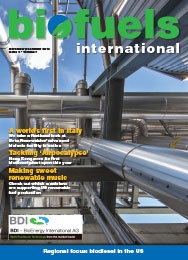
Volume 7, Issue 6
European biofuels cap: the verdict
Feature
The vote at the European Parliament concerning proposed changes to the Renewable Energy Directive (RED) and the Fuel Quality Directive (FQD) was taken mid-September. The use of cropbased biofuels for land transportation was passed and will be capped at 6% of the total 10% aimed for by 2020, but MEPs did agree to pass a 2.5% share from second generation biofuels. The final figure of 6% is...
[read more]
New ILUC studies could re-open biofuels debate
Feature
A new study conducted by Air Improvement Resource, consultancy (S&T) Squared and the University of Illinois Chicago concluded in much lower indirect land use change (ILUC) values for biodiesel and biofuels. Economic modelling applied to bioenergy has been heavily questioned recently. With successive reports proposing improvements in assumptions, the ILUC estimates on biofuels have decreased...
[read more]
Import worry still alive
Feature
European biodiesel producers have re-raised concerns about the delay of anti-subsidy decisions on overseas imports A decision by the European Commission to further delay its definitive anti-subsidy decision on biodiesel imports from Argentina and Indonesia, despite it disclosing a proposal for definitive anti-dumping duties in October, has sparked concern among European producers. As...
[read more]
Maturing US biodiesel industry wears scars
Feature
Comments from trade sources, corroborated by data from the federal government, shows ongoing growth in US biodiesel production, with the output rate expected to remain strong through the end of 2013. The monthly production rate has increased consistently from November 2012 through July according to the most recent data available from the Energy Information Administration (EIA), reaching record...
[read more]
New found FAME for Indonesia
Feature
As Indonesia moves to reduce the amount of fuel imported into the country, another country in South East Asia is looking to increase its biodiesel blend mandate A new regulation issued in Indonesia this summer is expected to lower the country’s fuel imports by at least 100,000 barrels per day (bpd) for the rest of 2013. The new rule, which is expected to reduce diesel imports while...
[read more]
Shining example
Feature
Despite reaching capacity early on, the Diamond Green Diesel facility in the US is still making improvements to ensure a bountiful future Diamond Green Diesel, a joint venture between Valero Energy and Darling International, has reached capacity during its start-up phase. The plant, based next to Valero’s St Charles refinery in Louisiana, US began operations this June and uses animal...
[read more]
The first of many
Feature
In early October over 600 people gathered in the quiet Italian countryside to witness the official opening of the world’s first advanced biofuels facility. The plant, located in Crescentino, has the capability to produce 75 million litres of cellulosic ethanol a year from agricultural waste. Production started back in late 2012 at 40,000 tonnes a year and is now being ramped up to full...
[read more]
On an upward trajectory
Feature
Figures released by the US Environmental Loss of tax credits, battling fraud and lacking ethanol’s longevity – despite all this, biodiesel seems to be becoming the US renewable fuel industry’s new king Protection Agency (EPA) over the summer put biodiesel production at 148 million gallons in August alone, making it a volume-to-date of over 916 million gallons. The US...
[read more]
Super-size me
Feature
The UK’s biggest bioethanol facility opened this summer. James Barrett caught up with Vivergo’s Rick Taylor to get the inside scoop When the £350 million (€416 million) Vivergo Fuels bioethanol plant in Hull, UK officially opened in July, the company became the country’s biggest bioethanol producer and largest single-source supplier of animal feed providing...
[read more]
Making sweet renewable music
Feature
One biodiesel supplier in the US has been hitting the right notes and reached a landmark in terms of production this year, but what does the future hold? In September US rock musician Neil Young extolled the virtues of renewable fuel to a gathering of the National Farmers Union while visiting Washington DC. Young revealed he does not get paid to air his views on biofuels and claimed:...
[read more]
Deciphering cryptic pathways
Feature
A research team in the UAE believes algae-to-biofuels is possible and is working in the harsh desert terrain of Abu Dhabi to try and prove it Algae-to-biofuels programmes have been battered by unfulfilled promises of cheap and plentiful biofuels for all. These programmes have traditionally relied on the isolation of freshwater algae species as sources of biomass for large-scale up, open...
[read more]
Grow your own biomass
Feature
A fresh look at cultivating and growing algae for biofuels production is coming out from a Swiss-based research and development company With global warming at the centre of global politics, new political initiatives, legislation and both public and private funding are focusing on sustainable sources of energy, including the key area of transportation fuels. As one of the most abundant...
[read more]
Second exit to biofuels
Feature
See how two men came together to begin a project aimed at producing biofuels from algae and how they ended up building a whole town The glowing green tanks on the second floor of the Goshen College Science Hall in Indiana, US look like something from a sci-fi movie. This is a fitting description however as the three clear plastic photobioreactors (PBR) have been designed with the future of...
[read more]
Obtaining those biofuels
Feature
A look at two distillation options available for the biofuels process Distillation is the most important first generation thermal separation process in use worldwide. Distillation separates components according to their specific vapour pressure at applied temperature. The volatile substance, in this case methyl ester, or low boiler, is evaporated while the high boiler remains in the...
[read more]
Spoilt for choice
Feature
A collaboration in the US has been aiming to achieve direct renewable fuels conversion from various different feedstocks via IH2 technology Three years ago two US-based companies, the Gas Technology Institute (GTI) in Illinois and CRI Catalysts in Texas, entered into an exclusive worldwide licensing agreement for GTI’s IH2 technology. This technology is a catalytic thermochemical...
[read more]
Knocking down barriers
Feature
What new steps are being looked at to unlock key sugars from lignocellulosic waste for the biofuels industry? The unsustainability of food crops as feedstock for biofuels and renewable chemicals has been well documented. Specifically, the finite amount of arable land available globally means the use of it for fuel instead of food has the predictable and undesirable consequence of putting...
[read more]
Keep disciplined
Feature
A bioethanol project in the Córdoba province of Argentina has been subject to a design and build project not centred on the norm Belgium-based De Smet Engineers and Contractors (DSEC) is implementing the construction of a corn processing plant with cogeneration facilities in Villa Maria, Argentina for farmers’ cooperative Asociación de Cooperativas Argentinas (ACA). It...
[read more]
Grand designs
Feature
Take a look at the process adopted by two companies separated over 7,000 miles to bring the largest bioethanol facility online in Argentina When bioethanol producer Promaìz planned to construct the largest facility in Argentina, it enlisted the help of Austria-based technology provider Vogelbusch. The plant recently began operations and this is its story of realisation. Biofuel...
[read more]
Facility of dreams
Feature
ASB Biodiesel CEO Anthony Dixon reveals his thoughts and aspirations as the first biodiesel plant opens in Hong Kong ASB Biodiesel is aiming to start producing biodiesel at its Hong Kong-based processing plant this November. Located at the Tseung Kwan O industrial estate in Kowloon, and backed to the tune of $165 million (€122 million) by the Al Salam Bank based in Bahrain, ASB is...
[read more]
Oxidative stabilisers for biodiesel
Feature
From a global perspective, the commercial introduction of biodiesel has proven to be a great success story. Thanks to mandates and targets being implemented in regions all over the world, both consumption and production have been rising and will inevitably continue to grow in order to meet the demands of a market which is far from having reached maturity. Yet the largest consumer and producer...
[read more]
Processing synthetic fuels from biomass
Feature
Large-scale fuel production from biomass can be limited by logistics, but one solution is offered by de-central pre-conversion and large-scale fuel synthesis A patented process named bioliq has been designed to overcome the logistical limitations when using a broad range of different types of biomass, many of which exhibit low volumetric energy densities like straw or forestry residues....
[read more]




 Loading ...