






← Go Back
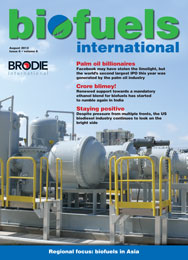
Volume 6, Issue 6
Staying positive
Feature
A pessimist would say if it wasn’t for bad luck some people would have no luck at all. Good then that the US biodiesel industry remains an assembly of optimists, with the hard times of 2010 no doubt already draining any lingering pessimists from their ranks. There is a federal mandate requiring biodiesel consumption, with this year’s Renewable Fuels Standard setting demand for...
[read more]
E15 finish line on US horizon
Feature
The approval means US retailers and producers will be able to sell fuel consisting 85% petrol and 15% ethanol, up-scaling from the current E10 model allowed throughout the country. The EPA, which first set the wheels in motion for this update in January 2011, has now completed a series of steps to ensure the new blend will be properly marked and sold. The E15 blend has been approved for...
[read more]
The road ahead for E15 implementation
Feature
A few years ago when the Environmental Protection Agency (EPA) granted partial waivers for E15 use in vehicle model years 2001 and newer, many wondered what this new fuel would mean for the retail motor fuels industry. The Renewable Fuels Standard (RFS), established by the federal Energy Policy Acts of 2005 and 2007, requires 36 billion gallons of renewable fuels to be blended into...
[read more]
Farm bill battle ends
Feature
The US biofuels industry is rejoicing after several potentially harmful amendments were dismissed by the Senate as it completed work on the 2012 Farm Bill in June. Senators filed hundreds of suggested amendments for consideration under the bill, but three of the strongest that would have made it difficult for the US Department of Agriculture (USDA) to assist the biofuels industry were...
[read more]
China: why the sudden interest?
Feature
This year is a big one for China as a new generation of leadership prepares to move into key government and communist party positions. The new generation of leadership will be making all key decisions for the world’s largest country for the next 10 years. The upcoming changes will occur at the 18th Chinese Communist Party National Congress in October when the rest of the world will be...
[read more]
India battles the biofuels blend
Feature
On 2 September 2002, over 2,000 people gathered in remote Monroe, Wisconsin to celebrate the opening of Badger State Ethanol, built by the design-build team of Fagen Witchita Falls, Wisconsin, and ICM from Colwich, Kansas. India is the world’s fourth largest consumer of petroleum products after the US, China and Japan and the sixth largest importer of crude oil. Seventy five percent...
[read more]
Crore blimey!
Feature
Ethanol is big business in India and is set to become an even more desirable product before the end of this decade. After a hesitant start, when the Indian government withdrew an initial mandatory 5% ethanol blend due to a reduction in sugarcane production in 2004, a national biofuels plan sets a 20% blended bar to come into effect by 2017. ‘New policies take a rather long time to...
[read more]
Ready and waiting
Feature
India, in terms of biofuels, is very much like Europe, the managing partner of software solutions provider Implico, Michael Martens, observes. Back in 2011 Germany implemented an E10 blend at the pump and motorists were wary, leading to production chaos and shortages of conventional petrol. This even resulted in some politicians calling that the mandate be scrapped altogether. A...
[read more]
Coming to fruition
Feature
The number of motorists on China’s roads are to increase dramatically from today’s 130 million to more than 200 million in 2020. This substantial growth will lead to a rise in demand for transportation fuel. But with an abundance of agricultural residues, China has the materials to be able to replace 40% of its yearly vehicle fuel consumption with second generation biofuels by...
[read more]
Palm oil billionaires
Feature
The biofuels sector rarely has a public offering that grabs the world’s attention the way Malaysia’s Federal Land Development Authority did in June. Felda was a market star in early summer, when its shares soared over 15% in the days after its debut on 26 June, raising over $3.1 billion (€2.5 billion). It has been a headline-maker in hundreds of newspapers and financial magazines...
[read more]
Averting jatastrophe
Feature
It can be difficult when your stock falls in other people’s eyes: the once bright, young thing full of hope and promise that doesn’t deliver expected results; the new kid on the block, full of swagger and forward thinking ideas, who eventually slinks off to lick their wounds after failing to evoke change. In the biofuels arena that sentiment could be used to describe the...
[read more]
BP at the Olympics: giving it 124%
Feature
BP, ahead of the start of the 2012 Olympic Games in London, announced it will use its position as event partner to springboard its latest advance in biofuels technology. As the official supplier of oil and gas to the Games, BP will provide fuels and lubricants to a fleet of over 5,000 BMW-supplied vehicles throughout July and August including one based on a 24% biobutanol-blended petrol....
[read more]
Butanolâ
Feature
On 2 September 2002, over 2,000 people gathered in remote Monroe, Wisconsin to celebrate the opening of Badger State Ethanol, built by the design-build team of Fagen Witchita Falls, Wisconsin, and ICM, Colwich, Kansas. It was the celebration of the emergence of the ethanol industry, built by a design and engineering partnership eventually responsible for 60% of US ethanol production...
[read more]
Dealing with the badly behaved
Feature
According to the American Society for Training and Development (ASTD), US companies spent over $171.5 billion (€136 billion) on learning and development programmes for employees in 2010, the latest statistics available. Within this expenditure, management and supervisory learning is the leading type of content. And while the return on investment is substantial, companies find that in...
[read more]
Thinking outside the box
Feature
While many biofuel companies in the Western world speak of helping third world countries grow their economies, many are in fact doing the opposite. Instead of establishing a local supply chain, a number of companies purchase the initial product from developing nations but then add value elsewhere, in Rotterdam, Finland or the UK, for example. Transporting the feedstock from the...
[read more]





 Loading ...