






← Go Back
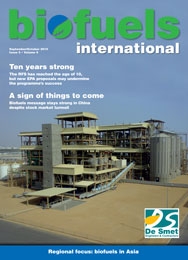
Volume 9, Issue 5
Ten years strong
Feature
2015 is an important year for the US Renewable Fuel Standard (RFS) in many ways. First of all, it marks the programme’s 10th anniversary. Signed into legislation in 2005 as part of the Energy Policy Act, the RFS has aimed to increase US energy independency while simultaneously preserving the environment by requiring an increasing amount of ethanol to be blended with petrol. The Renewable...
[read more]
Tax credits for biofuels
Feature
The US Senate Finance Committee (SFC) has passed a package of $95 billion (€86 billion) in tax credit extensions. The bill contains a provision extending the $1.01 per gallon production tax credit for cellulosic biofuels, which expired at the end of last year. Under the legislation, the cellulosic biofuels producer tax credit would be extended for two years, through 2016. Upon receiving...
[read more]
Current price index
Feature
Physical shortages in Rotterdam combined with stronger end user demand and consequently higher blending levels saw the European ethanol market improving its already impressive summer performance. Production closures and run cuts in Europe pushed spot duty paid prices briefly to €600/ m³, the highest since April. The gains opened a shortlived arbitrage window for volumes to move to...
[read more]
Hot topic
Feature
The downtrend in US and global oil prices was expected to incentivise demand for refined fuels. Petrol demand in the US has responded, running 4.2% higher in 2015 through late August than year prior at 9.141 million barrels per day (bpd). According to government data, the demand rate accelerated during the summer months. Yet, the memo has not reached diesel fuel end users. Implied distillate...
[read more]
A sign of things to come
Feature
The stock market turmoil which hit China in August will have rung alarm bells for investors across many sectors, including those who are committed to biofuels development within the country or whose business models include the Chinese marketplace as a key target for products and new technology. How loud the bells will ring, and for how long, will depend on the length of time it takes for global...
[read more]
Cracking down on breakdowns
Feature
Organisations of all kinds are increasingly aware of the need to maximise the value of their asset base. Manufacturers – particularly those with multiple-phase processes such as those required for biofuels production – are under particular pressure. Increased energy, labour and materials costs, combined with downward price pressure from customers, can result in a ‘perfect...
[read more]
Mapping the customer journey
Feature
When it comes to creating ethanol, production efficiency is key. When a machine breaks down, having it repaired quickly is a must. One thing that makes repairing equipment and preventing future breakdowns easier is a computerised maintenance management system (CMMS). A CMMS is a software program designed specifically to help facilities be more efficient by decreasing machine downtime and repairs....
[read more]
Gaining momentum
Feature
As the world continues to seek long term, sustainable and healthy options for food, fuel and energy, the potential of algae is increasingly being seen as a key solution. Algae can contain high levels of oils, carbohydrates, sugars and proteins, and can be used to produce renewable fuel, animal feed and even human food. In fact, algae – both micro- and macroalgae (seaweeds) – are...
[read more]
The future of fuel
Feature
Around 3.6 billion tonnes of carbon dioxide (CO2) burden and fill the atmosphere each year from stationary sources in the US alone. When expanding to a global scale and including non-stationary sources, it becomes glaringly evident that the world is in absolute desperate need for a portfolio of solutions to economically mitigate CO2. We are already dangerously close to the point of no return with...
[read more]
Screening for gold
Feature
How far can we go in our quest for large-scale biofuel production? It is a question regularly posed by industry and the science community, as the world seeks alternative fuel sources. The search is a complex one; it is not just about the levels of fatty acids produced by the organisms but the identity of the lipids they produce, the overall biomass productivity of the chosen strain, how easy it...
[read more]
Algae as an alternative
Feature
The Integrated Seawater Energy and Agriculture System (ISEAS) launched earlier this year at Masdar City, Abu Dhabi, and is expected to be up and running by October 2015. The research is being conducted by the Sustainable Bioenergy Research Center, a non-profit consortium established by Masdar. If all goes according to plan, Abu Dhabi could soon be rolling out a completely sustainable, plant-based...
[read more]
A is for Acrocomia
Feature
Jatropha curcas is an important feedstock for the future production of renewable energy. It is still in the early stages of domestication, however, giving hope of improved performance in the future. Another plant in a similar stage of development as Jatropha curcas is Acrocomia aculeata – a species of palm native to tropical regions of the Americas. Acrocomia aculeata has huge potential for...
[read more]
Joint effort
Feature
Biodiesel (fatty acids short-chain alkyl esters) obtained from renewable sources such as vegetable oil is a promising alternative fuel to replace petroleumbased diesel. With the hiking prices of vegetable oils and the recent controversy in using virgin vegetable oils for the production of renewable fuels instead of using the product for food supply, biodiesel producers are being urged to move to...
[read more]
The bolt-on esters
Feature
The use of distillers corn oil for the production of biodiesel has increased dramatically in recent years. In this same period ethanol plants have begun recovering their corn oil in mass, going from just a handful of plants to nearuniversal adoption in just a few years. During tough years for the ethanol industry, the revenue from corn oil has often been the difference between profitability and...
[read more]





 Loading ...