






← Go Back
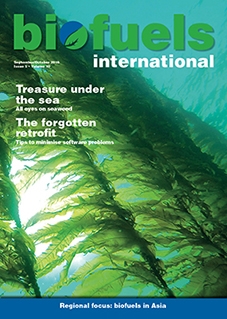
Volume 10, Issue 5
Current price index
Feature
FAME 0c continues to be the most actively traded grade on a FOB ARA basis as oil companies continue to maximise their summer blending programmes. As aresult of this, the premium for RME over FAME 0c remains negligibly thin. In part this isdue to North West European buyers focusing on 0c CFPP, but also as there remains a lack of blend stock availability.
Trouble on the horizon
Feature
Following progressively higher output of biomass-based diesel in the US during the first six months of 2016, producers dialled back their yield in July to a three-month low and shrunk the year-on-year increase in monthly output to 5.9% froma double-digit growth rate realised each month during the first half of the year.
Exciting future, tame present
Feature
The prospect for biofuel developments across Asia is always interesting and exciting but not always as achievable in terms of real progress as the individual governments might like to believe. The enormous size of the marketplace and the universal desire to replace imported fossil fuels by domestically-produced alternatives ensures the unveiling of a steady stream of projects, trials, and...
[read more]
Treasure under the sea
Feature
It has been claimed that seaweed – or macro-algae– is the largest unexploited resource on our planet. Our oceans harbour more than 10,000 species, but we have just barely begun to harvest and cultivate them for our benefit. This is puzzling, considering that seaweed may just be the perfect biomass crop: no fertilisers, no fresh water, no pesticides, no land use, no food-for-fuel...
[read more]
Algae today
Feature
Sustainable production of high volumes of biofuels and bioproducts requires expanding beyond using solely traditional sugar and starch-based crops. The role microalgae can play in biofuels production has been known since the mid-20th Century. Algae, because of their high energy density and high lipid production rates from a relatively small cultivation footprint compared to terrestrial feedstocks...
[read more]
No harm intended
Feature
To make diesel fuel and biodiesel (FAME) safe to use, a variety of additives can be used. Among these, middle distillate flow improvers (MDFI)or biodiesel flow improvers(BDFI) and wax anti-settlingadditives (WASA) are added to improve the fuels’ low temperature performance. Cetane number enhancers are added for better combustion and oxidation stabilisers are used for higher stability.
Adding to the mix
Feature
Used cooking oils(UCO) are becoming more and more interesting for the production of biodiesel, especially after the restriction of the European Directive2015/1513, which limits theuse of biofuels deriving from food crops. UCOs are listed in the part B of the AnnexIX among the raw materials which are not considered “advanced” but can count twice their energetic content, except for...
[read more]
Down with deposits
Feature
With operational costs rising in many areasof an ethanol production facility, profit margins continue to get tighter and tighter. Enhancements made to the production process itself are one way that plant operations can help to increase yield and efficiency, improving the overall profitability of the facility.
Keep one's cool
Feature
Microbial control inthe cooling water systems of ethanol plants can be aschallenging as it is important. That was the recent casewith a 190 million lpy ethanol production facility in the US. As part of an ongoing maintenance programme, the plant’s operators were using a chlorine oxidant programme to control bacteria and algae in the cooling system. The results, however, were unsatisfactory....
[read more]
Options for reuse
Feature
Every day in the US, more than 355 billion gallons of water are withdrawn from surface and ground water sources to serve industry and the public, according to a 2010 report from the US Geological Survey. As the strain on water sources steadily increases, it is critical for all waterusers to work towards water conservation.
Legionella under the microscope
Feature
Any water treatment professional can rapidly cite the benefits of controlling scale, corrosion, fouling, and microbial contamination prevention in cooling water systems. These issues have long been the foundation of cooling water treatment, and much of the focus with microbiological control has revolved around bacteria, fungi, and algae.
Control system software: The forgotten retrofit
Feature
Sometime in the summer of 2015 a new icon appeared on Windows desktops worldwide. It announced the arrival of Windows 10, urging PC users to upgrade immediately, and thereby reap numerous performance benefitsat zero cost. This icon caused many system integrators and automation programmer sto cringe. Why? Because they knew that the real cost of upgrading isn’t limited to the price of a...
[read more]
Staying ahead of the risk curve
Feature
Like any commodity-driven industry, ethanol production involves risk. Eroding profit margins, mismanaged buyingand selling decisions, and shifts in global supply and demand are all risks that threaten the ability of business leaders to make balanced decisions.
Which are the most sustainable biofuels?
Feature
Advanced biofuels are in the news asthe EU considers the role of biofuels in transport post-2020. The European Commission (EC) recently published a report titled European Strategy for Low-Emission Mobility,which confirmed the need for biofuels for decarbonising transport, particularly aviation and heavy-duty transport into the future.
Re-recognition of sustainability certification schemes
Feature
On 9 August, International Sustainability and Carbon Certification (ISCC) was re-recognised by the European Commission (EC). This occasion provides a good opportunity to draw conclusions from five years of operations, introduce some core changes, and take a look into the future.
On the fast lane
Feature
The EU targets a 40% reduction in greenhouse gas(GHG) emissions by 2030 and strategies,including reducing the carbon intensity of transport, are being shaped during this year. In July 2016, the EuropeanCommission (EC) released a communication paper for low-emission transport and set binding GHG emission targets for member states for the period 2021–2030. The decisions’ goal is clear -...
[read more]
Straw into fuels
Feature
Inbicon is a technology company, owned by Danish Dong Energy, specialising in technology and know how for converting non-food biomass to second-generation bioethanol and valuable products for renewable power. Eight years ago, a demonstration plant was built in its refinery in Kalundborg ,Denmark, to test and proof Inbicon’s technology.
Screening for biofuels
Feature
B Green Group sees a future in converting restaurant waste oil, fat, and grease into biofuels. According to the National Renewable Energy Laboratory (NREL),1.81 billion kg of trap grease available in the US each year could yield about 1.9 billionlitres of biodiesel instead of ending up in municipal waste streams. The figures for oils and fats are similar.





 Loading ...