






← Go Back
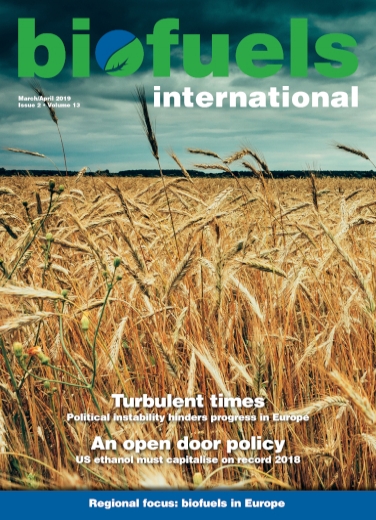
Volume 13, Issue 2
The post-REDII waste biodiesel conundrum
Feature
With the entry into force of the revision of the renewable energy directive (REDII) in December 2018, following months of intense negotiations, the European Union (EU) biofuels industry at large entered a no less important phase in which Member States have to put in place the necessary national REDII implementing legislation ahead of the 31 June 2021 transposition deadline.
Biodiesel drives the US work truck industry
Feature
As the future of the transportation industry continues to evolve, there is one thing we know for sure; work needs to be done. Multiple studies show that diesel engines will continue to be the industry’s preferred workhorses for many years to come. And biodiesel, America’s Advanced Biofuel, has an important role to play.
An open door policy
Feature
Earlier this year, the US Department of Agriculture’s (USDA) Foreign Agricultural Service (FAS) released the final 2018 ethanol export numbers – bringing the year to a record 1.7 billion gallons in exports. Last year marked the sixth consecutive year of continuous growth in ethanol exports, with 2018 seeing an impressive 23.7% increase in exports from 2017, which translates to an...
[read more]
Seizing the opportunity
Feature
The EU is committed to carbon neutrality by the middle of the century, but long-term objectives require ambitious action today. The clean energy and climate package, including a set of legislations to ensure the EU is on track to reduce greenhouse gas(GHG) emissions by at least 40% by 2030, have now all been adopted. Now is the time to reconcile the REDII and climate ambition in EU Member States.
Lost demand
Feature
Soy methyl ester biodiesel at key hubs in New York Harbor, Chicago and Houston traded at $0.70 to $0.95 gallon premiums to nearest delivered ULSD futures on the New York Mercantile Exchange in February and March, down sharply from the $1.10 to mid-$1.30 gallon premiums traded year prior, with the current weakness emerging in the second quarter 2018.
Uncertainty remains
Feature
Relative to a European biodiesel market sedately transitioning from winter to summer demand, US biofuels traders have had to negotiate logistical turmoil due to flooding across much of the Midcontinent, which has disrupted product flows from the Midwest production hub to the main demand centres in the Gulf and on the US West Coast. US biodiesel output has otherwise been making slow progress, with...
[read more]
Europe's political turmoil invades REDII tranquillity
Feature
Running any type of business in Europe is challenging enough at present, let alone one loaded with the additional pressures generated by the region’s slow march towards the development of biofuels as a major contributor to the continent’s energy mix. Not only do we have Brexit overhanging the EU, with all the doubt and indecision that includes, but also the need to negotiate a new...
[read more]
Finland's bold biofuel targets
Feature
Emissions from road transport are considered more harmful than those from other sources, as most emissions occur in urban areas where people live and work. Nitrogen oxides (NOx) and particulate matter (PM) are the worst pollutants in exhaust gases. Wood-based UPM BioVerno diesel reduces these air polluting emissions.
How camel crickets may boost biofuels
Feature
Chemical and enzymatic degradation of wood (lignocellulose) has long been the focus of the biofuel industry. The use of lignocellulose as a feedstock for biofuel production prevents competition with crops used for food. Researchers have discovered a new bacterial species from the camel cricket associated with lignin bioconversion of industrial waste, which could have considerable implications for...
[read more]
Unlocking the promise of bioindustrial technology
Feature
Over the past two decades, there has been tremendous progress in the bioindustrial space. Driven by the need for fossil resource alternatives, we have seen the massive growth of corn- and sugarcane-based biofuels in the United States and Brazil. Technologies that can hydrolyse cellulosic biomass are crucial to delivering meaninful volumes of sustainable fuels, as Renmatix explains.
Keeping it local
Feature
Founded in 2009, Neutral Fuels, part of The Neutral Group, converts used cooking oil into biodiesel, a sustainable replacement for fossil fuel-based diesel. Taking the customer as a starting point, the company has constructed clean, efficient working systems to offer higher quality, higher yielding biodiesel, produced at a profit and without subsidies. We speak with founder, chairman and CEO Karl...
[read more]






 Loading ...