






← Go Back
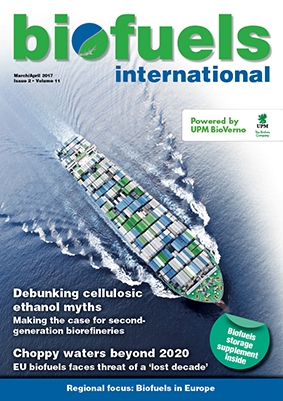
Volume 11, Issue 2
Trimming down the process
Feature
When using environmentally friendly biofuels,the development of new, sustainable technologies is more important these days than ever. Political demand for biofuel technologies with high greenhouse gas-saving potential leads to the preference of biofuels using waste material as feedstock. In particular, all kinds of oil and fat feedstocks will play a significant role in the future feedstock mix...
[read more]
New unknowns for maturing US biodiesel industry
Feature
Soy-methyl ester 100% biodiesel physicalspot prices were under pressure at key trading hubs in the US midway through the first quarter in very limited trade as the loss of a $1 gallon blending credit and weakening values for Renewable Identification Numbers (RINs) pressed prices lower.
A sustainable solution
Feature
REDcert was founded on 26 February, 2010, by leading associations and organisations in the German agricultural and biofuel sector and approved as a certification system on 20 July, 2010, by the Federa lAgency for Agriculture and Food (Bundesanstaltfür Landwirtschaft und Ernährung – BLE) to fulfil the requirements of the German Biomass Sustainability Ordinances (BioSt-NachVand...
[read more]
Chasing certifications
Feature
Setting legal sustainability requirements for biofuels and bioliquids has been a pioneering undertaking by European Parliament and Council. The Renewable EnergyDirective (RED) and Fuel Quality Directive (FQD) have triggered the transformation of the entire market. This has been achieved in a very short period of time.
The road beyond 2020
Feature
Biofuels specialists in Europe are concerned that the 2020s will become a lost decade for climate and environmental protection in relation to the transport sector with some major opportunities to develop alternative fuels being lost while governments wait for the electrification of road vehicles to take over from today’s fossil fuels-based structures.
The three myths of cellulosic ethanol in Europe
Feature
Throughout Europe,countries are taking different approaches toward their carbon neutrality goals. But they all have one thing in common – they are each taking meaningful steps toward decarbonising the transportation sector, which makes up more than 25% of the greenhouse gas (GHG)emissions in the EU.
Entering into a new paradigm
Feature
According to the Ellen MacArthurFoundation, the circular economyis “one that is restorativeand regenerative by design,and which aims to keep products, components andmaterials at their highest utility and value at all times, distinguishing between technical and biological cycles.”
Cleaner marine shipping with advanced biofuels
Feature
Maritime transport is looking for new ways to reduce carbon dioxide and sulphur emissions. At the beginning of 2017, the Marine Environment ProtectionCommittee of the International Maritime Organization (IMO)adopted a global sulphur cap requiring all ships to use fuels with a maximum 0.5% sulphur content, as of 1 January, 2020.
The value of contracted piloting
Feature
In developing new and existing fermentation processes, there are many unknowns that need to be characterised to deliver the right solution to the full-scale design. Production capacity, recycle stream impacts, waste generation, and supply logistics are all critical to realising a commercially competitive process.
Pushing the limits on yield
Feature
As margins between product value and inputs costs continue to put pressure on producers of fuel ethanol facilities to operate more efficiently, particularly as blend requirements fluctuate seasonally, there is a competitive advantage for producers in beingable to yield more ethanol from less grain, cane,cellulosic, or other sugar bearing feedstock.
Small and sweet
Feature
With the biofuel industry slammed by low oil prices and low natural gas costs, innovators continue to seek methods to expand the biomass base and value-added products.Advances in fermentationare key to this success. In a statement about a recent US Senate hearing, the Renewable Fuels Association(RFA) noted that DuPont,POET/DSM, Quad County Corn Processors, East Kansas Agri-Energy, CHS,...
[read more]
RED II: Room for improvement
Feature
The future of the EU biofuels markets is at across roads, yet again. In late 2016, the European Commission (EC) proposed a comprehensive revision of the Renewable Energy Directive(RED), containing the EU’skey regulatory provisions on biofuels. The original directive had been adopted in 2009 and then amended in 2015, after the particularly tortuous legislative passage of the so-called ILUC...
[read more]
Vopak beefs up biofuels capabilities with new infrastructure at Deer Park
Feature
Dutch tank storage company Royal Vopak has announced that it will expand its Texas-based terminal. Vopak’s Terminal Deer Park will now add 868,000 barrels of new capacity to its current 7,013,787 barrels.
Digital collaboration
Feature
The availability of advanced digital technologies, such as big data, analytics,cloud and connected devices, is driving new opportunities to integrate storage terminal operations. Research conducted by Accenture into collaboration at tank terminals has created an outline of the current digital maturity in the market, and suggests there is still a lot of scope to grow.
New horizons
Feature
Westway Terminals last year rebranded with a new name, new logo and new growth strategy. It is now called Contanda. As a leader in bulk liquid storage solutions for more than 60 years, Contanda continues to evolve and focus on what CEO Jerry Cardillo calls a transformation and growth journey that he expects will more than double its size in five years.
Making waves
Feature
Vesta Terminals is an independent liquid bulk storage operator in Europe with a total of approximately 1.6 million cubic metres of petroleum products andbiofuels capacity at three terminals in Antwerp, Belgium, Flushing, the Netherlands, and Tallinn, Estonia. Here, Liz Gyekye interviews Vesta’sCEO, Martijn Notten.
Separating the good from the bad
Feature
For owners of above ground process storage tanks, including both atmospheric and pressurised storage systems such as bullets and spheres, tank inspection programmes are normally based around EEMUA 157and/or API 653. According to both of these standards, the purpose of an inspectionis to determine if tanks are safe for continued service in terms of their mechanical integrity.
Back to Rotterdam
Feature
StocExpo Europe, the world’s leading international event for the tank terminal industry, returns to the Ahoy Rotterdam on 28-30 March, after a year in Antwerp. The three-day conference and exhibition will bring together thousands of storage professionals from across the globe to network, learn, share knowledge and do business.
Major tools for quality assurance
Feature
For an efficient quality management system, different tools should be taken into account. One of them, for example, is a certification according to ISO 9001 or a similar system. ISO 9001 includes the minimum requirements for a quality management system that need to be fulfilled to ensure a good quality of the products and to meet all regulatory requirements.
From waste to riches
Feature
In March 2016, anannouncement was made regarding ENC Energy technology for oil extraction/recovery from waste fats, oils and grease (FOG). With the construction, commissioning and industrial operation of the demonstration plant in SantaMaria da Feira, Portugal, now called Resiway, the process engineering design concept was validated.
Lignin's time is now
Feature
Often, it is presumed that lignin has numerous applications butl imited business opportunities. Once separated from cellulose, the bio-based polymer isregularly used for energy purposes by the pulp industry. It is burned to produce heat, steam and electricity, which generates more energy than the pulp mill uses.




 Loading ...