






← Go Back
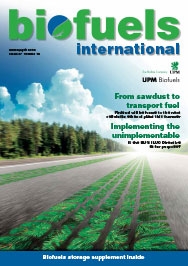
Volume 10, Issue 2
Big Interview
Feature
Clariant, a Swissspeciality chemicals manufacturer,has invested ininnovative technology to promote cellulosic biofuels. Liz Gyekye caught up withthe company’s biofuels andderivatives head of businessdevelopment, Paolo Corvo,(pictured right) to find out more. Where do you expectdemand to come from?The global energy landscape is constantly changing.We are facing a growing list of...
[read more]
Automating advanced biofuels development
Feature
For decades, consumers around the world havedepended on fossilfuels such as gas and oil to meet their energy requirements. Although they are continually beingformed through natural processes, fossil fuels arewidely considered to be non-renewable resources. They take extended periodsof time to form, and thecurrently available reserves are being consumed at a far greater rate than they are being...
[read more]
2017: A road fuel odyssey
Feature
From 2017, the European sugarmarket deregulates. Production quotas – themainstay sugar production– will be swept away, along with guaranteed prices. Along with that, Europe’s splendidisolation within the sugar world,barricaded away behind the World Trade Organization’s(WTO) enforced limitations,should also come to an end and Europe’s sugar industry willemerge...
[read more]
Implementing the unimplementable
Feature
Ten months after the European Parliament formally adopted the much-debated Indirect Land Use Change (ILUC) Directive, the policy is still dividing opinions acrossEurope. The main purpose of ILUC is to start the transitionfrom conventional biofuels to biofuels that deliver substantialgreenhouse gas (GHG )savings. That was the viewexpressed by the EuropeanCouncil after it also adopted the Directive...
[read more]
Making of a certain sector
Feature
The Indirect Land UseChange (ILUC) theory has been linked to biofuels over the last few years. It generally refers to the unintended consequence of releasing more carbon emissions due to land use changes around the world than would be saved by using the bioproduct. The emissions are linked to the increased expansion of croplands for biofuel (bioethanol andbiodiesel) production. In other words,...
[read more]
Strength in sustainability
Feature
Responsibility is about values,commitments andactions. It is shown every day that innovative and responsible business canbe efficient and profitable,bringing quality of life andprosperity to stakeholders. For decades, efforts have been put in responsible forest management, traceability,sourcing and supply chains. For our company, driving top performance is clearly linked to sustainability....
[read more]
Attack of the clones
Feature
The development of an extensive hydrotreatedvegetableoil (HVO) feedstock production enterprise in Paraguay, funded by French, Dutch, and UK investors,reached a significant milestone in February with the completion of a propagation site and greenhouse infrastructure for Pongamia, the nitrogen-fixing tree on which the work is based. “Traditionally grown in Indiaand Australia, Pongamiais a...
[read more]
Giving credit where it's due
Feature
The US Congress passed in last December a tax extenders package to retroactively extend a blenders’ tax credit for biodiesel and a producers’credit for cellulosic biofuels from the beginning of 2015 through 2016. The $1 per gallon biodiesel and the $1.01 per gallon cellulosic biofuel credits were long awaited in the industry,which has been struggling with uncertain legislation. The...
[read more]
No dumping on China
Feature
China’s Ministry of Commerce (MoC)has launched anti-dumpingand countervailing duties investigations on US dried distillers grains with solubles(DDGS) imports. The move, announced mid-January,comes after complaints from Chinese producers that DDGS from the US were sold at prices “below normalvalue”, which hurts domestic industry. The MoC received in November 2015 an official...
[read more]
Mircoalgae in industry
Feature
Microalgae,single-celled photosynthetic organisms, have great potential as a renewablesource for a tremendousrange of commercial products,such as biofuels, foods and feed (human and animal),nutraceuticals and healthfoods, industrial chemicals,and even pharmaceuticals. In addition, the ability of algae to grow across a wide-rangeof environmental conditions, coupled with a relatively...
[read more]
Extracting oils from 'ugly' wastes
Feature
Many people haveheard of theexpression “where there is muck, thereis brass”. Yet, not many wouldhave heard the saying “where there is muck, there is oil”. The resource management industry in Portugal is due to get used to this expression, especially after recentlylaunching Portugal’s firstwaste-to-oil facility in Santa Maria da Feira, basedin the northwest of...
[read more]
The path to commercialisation
Feature
In December 2015 anannouncement was made regarding the planned construction of a 5 tonnes per day IH2 technology demonstration plant on thesite of Shell India Markets’new technology centrein Bangalore, India.This technology isa continuous catalytic thermochemical process that converts a broad range o fbiomass and organic residuesinto ‘drop-in’ hydrocarbonliquid fuels that are...
[read more]
Achieving effective fermentation
Feature
One part that seemsto slip past thefocus in fuel ethanol plant fermentation is how to make the process efficient and how to create a healthy, fast, and thorough fermentation. One of the most overlooked portionsof fermentation is the ability to maintain a healthy viable yeast cell through nutrition.To provide an efficient effective fermentation (EEF)in the biofuels industry,yeast must remain...
[read more]
Out with the old
Feature
Crimson Renewable Energy owns and operates a biodiesel production facility in Bakersfield, California, that is currently the largest producer of biodiesel within the statein terms of actual volumes shipped. Yet the plant did not start out this way, and it was originally designed in houseand built in 2009 as a biodiesel plant engineered to process virgin vegetable oils.Crimson performed...
[read more]
Bio-based building blocks
Feature
With new economic conditions,2016 apparently started as a challenging year. Yet this new environment does not alter the perspectives for bio-basedchemicals. Feedstocks are stil llow, advanced economies are showing stronger growth, and value has moved downstreamof the value chain. Bio-basedchemicals appear as a solution to provide downstream diversification for biobased feedstock producersand...
[read more]
Making sense of it all
Feature
We are currently in the third generation of biofuels production, where custom engineered micro-organisms are used to convert feedstock to fuel more efficiently and cost effectively. But with this new opportunity comes significantly more complex processes and risks of costly failure. Third generation biofuels producers must rely on next generation laboratories that are prepared for increased data...
[read more]
Good storage practice: ensuring high quality biodiesel
Feature
The extensive use of biodiesel as a component in diese lfuel or bio-basedheating oil leads to increased requirements for storage and long-term stability. In a nine-month storage testabout the stability of fatty acid methyl ester (FAME )from rapeseed oil underideal and realistic conditions(Biofuels InternationalMarch/April 2015), it was shown that biodiesel preserved an excellent quality if stored...
[read more]
Biofuel quality issues
Feature
In 2010, Minton, Treharne & Davies (MTD), a UK-based engineer consultancy,produced an article for the Carefully to Carry Advisory Committee of the UK P&I Club,in which it discussed issues relating to the marine transport, handling, and storage of biofuels. Since that time, MTD has been involved in a number of claims investigations into alleged quality issues concerning biofuel cargoes...
[read more]
All on board?
Feature
Platts publishes several fuel ethanol price benchmarks tailored to specific markets in the US, Brazil, Europe and Asia that are used by the industry to manage risk in this growing market and along the entire transport fuels chain. Following market feedback last year, it announced that it would change its Free on Board(FOB) Rotterdam T2 ethanolassessments to reflect a FOB Rotterdam basis, with...
[read more]
Working on tankers: Safety in storage
Feature
The biofuels industry is full of risks. There are risks associated withhandling products andrisks connected with using and repairing equipment. Loadtec Engineered Systemswas set up almost 20 yearsago primarily to sell loadingarms, but increasingly, the company is supplying total solutions that make a difference to the whole working environment.
Hydrothermal liquefaction of biomass: a pilot plant
Feature
Whilst a wide range of sustainable solutions for our general energy demand are becoming increasingly available, there still exists the need for new and ever more efficient methods of providing sustainable liquid fuels for transport as well as carbon-based chemicals and materials. In other words, we are moving from an energy challenge towards a carbon challenge. Converting biomass into such value...
[read more]





 Loading ...