






← Go Back
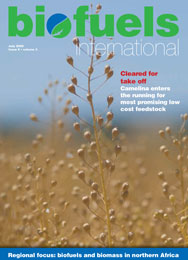
Volume 3, Issue 6
EU biodiesel industry shows resilience
Feature
In line with the trend initiated in 2007, 2008 saw a relatively low increase in EU biodiesel production, and a reduction in two major producing member states, Germany and Austria. With 7.7 million tonnes, 2008 production increased by only 35.7% compared to the 2007 level (up from 5.7 million tonnes). 2007 already saw a reduced 16.8% increase compared to 2006. This has to be compared with 2005 and...
[read more]
A happy conclusion – for some
Feature
After much debate the EU has come to a conclusion and approved the anti-dumping and countervailing measures against US biofuels exports. The temporary fees imposed in March will be extended for five more years beginning on 12 July. Unsurprisingly, the National Biodiesel Board’s (NBB) reaction was a strong one. ‘This is an unfortunate decision,’ states Manning Feraci, VP of federal affairs....
[read more]
Your questions answered
Feature
QAccording to the Renewable Energy Directive, what are the sustainability criteria for biofuels in the EU? A The sustainability criteria are laid down in Article 17 of Directive 2009/28/EC (published in the Offi cial Journal of the European Union on 5 June 2009 (L 140/16)) and include the environmental and social dimension. Failing to comply with those criteria means the biofuel will neither...
[read more]
Bill throws US biodiesel a lifeline
Feature
On 26 June, the US House of Representatives narrowly passed the American Clean Energy and Security Act of 2009 with 219 votes, which includes a national cap-and-trade programme aimed at reducing greenhouse gas emissions. The programme is controversial in the US, and the bill had required 218 votes to advance. A compromise was needed, which was negotiated by Collin Peterson, D-Minn., chairman of...
[read more]
Not just jatropha
Feature
It has been a slow start in Africa. But community operations are gradually raising the profi le of renewable fuel, once tarnished by its link to food production, a sensitive issue in a continent that is ravaged by famine and poverty. Recent happenings in Sudan have also boosted the commercial side of the green fuel sector, with a little external help from experienced nations. The country’s fi rst...
[read more]
Plant construction update - northern Africa
Feature
Nowhere in the world is the food-versusfuel debate more pertinent than in Africa. North of the equator the continent is seeing a wave of urbanisation raising the demand for fuel and due to today’s hiked oil prices, many countries have begun to turn to biofuels as a viable, renewable and cheaper alternative to dwindling crude oil reserves. This demand combined with the potential of foreign...
[read more]
Green aviation to take off in three years
Feature
The ability to fly conveniently and efficiently between nations has been a catalyst for the global economy and has shrunk cultural barriers like no other transport sector. But this progress comes at a cost. In 2008, the commercial aviation industry produced 677 million tonnes of carbon dioxide (CO2), around 2% of the total man-made CO2 emissions of more than 34 billion tonnes. While this amount...
[read more]
Hydrous ethanol: opportunities for supply and demand
Feature
Ethanol is produced and used in hydrous (wet) and anhydrous (dry) forms, the latter requiring an additional costly and energy consuming drying process. An opportunity therefore exists for both producers and end users in maximising the use of hydrous ethanol, this increasingly having stimulated R&D on both the supply and demand sides. Ethanol as a fuel today Hydrous ethanol is produced from...
[read more]
The power of hydrous ethanol
Feature
Scientifi c research organisation TNO has just completed tests measuring the emissions and running capabilities of several low blend hydrous ethanol fuels. A representative modern car (a Ford Mondeo) was tested on three different fuels: petrol, a mixture of petrol and hydrous ethanol and a mixture of petrol and anhydrous ethanol. Two other petrol vehicles were also used to verify the emission...
[read more]
Cleared for take off
Feature
The old adage tells us that sometimes before moving forward, you have to take a step back to appreciate what has come before. Camelina, which has gone under several aliases including false fl ax and gold of pleasure, is an ancient Mediterranean crop that had been grown for various uses throughout history. In antiquity it was cultivated from Rome to southeastern Europe and the southwestern Asian...
[read more]
Size matters
Feature
A crucial factor when moving biomass is the bulk density – weight is rarely a problem. Loose plant-based biomass has a low bulk density ranging from 50 to 130 kg/m3 depending on the plant species, particle density, and particle size. Particle size makes a huge difference, although tree trunks and sawdust might have the same particle density, you can pack sawdust tighter than a stack of logs. Much...
[read more]
Algae: a commercial economics perspective
Feature
Technical maturity and commercial viability of algal biofuels is a much debated topic, with estimates ranging from three years to (multiple) decades. However, most people involved in this emerging technology area agree that algal biofuel commercial economics are extremely challenging, highly variable, and subject to dynamic, speculative, and volatile commodity markets. On 3 June 2009 the US...
[read more]
Oil extraction options
Feature
Oil mill technology is well established, with an increasing number of farmers considering seed oil expulsion for biofuel production, if the market becomes sufficiently lucrative. The majority of oil pressing is carried out by big players in the food oil and biofuel arena like Cargill, ADM, Bunge and others. Rapeseed oil initially contains about 40% oil and the biodiesel aim is to reduce residual...
[read more]





 Loading ...