






← Go Back
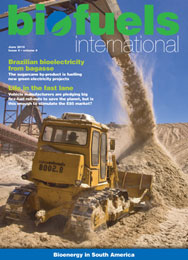
Volume 4, Issue 5
A turning point?
Feature
Just over a month ago US President Barack Obama was calling for more offshore drilling to strengthen the US economy and promote energy independence. But since the oil spill, the US administration has banned oil drilling in new areas of the US coast, so biofuels may again become flavour of the month. On the surface it would be easy to say that compared to over 5,000 barrels of oil a day leaking...
[read more]
German law to thwart EU renewables targets
Feature
Until three years ago, Germany’s hefty fuel taxes were waived for biodiesel, giving B100 a competitive edge at the fuel pump resulting in rising biodiesel sales at public filling stations each year between 2001 and 2005. But in August 2006 the German government began phasing in fuel taxes on biodiesel beginning with €0.09 a litre until January 2008, when they rose by another €0.06 a litre. The...
[read more]
When everything falls into place
Feature
The strengths and competitive advantages of Argentina have contributed to the growth of many projects focused on the production of biodiesel over for the last three years. Patagonia Bioenergia is a good example – its plant is one of the largest in the world. Construction began in 2007 and successful commissioning took place in 2008, with a production capacity of 250,000 tonnes of biodiesel a...
[read more]
Argentina's domestic market takes off
Feature
Argentina is already the world’s fifth largest biodiesel producer with more than 1.2 million tonnes produced in 2009, thanks to its abundance of soya oil. And following Brazil’s lead, Argentina is making the most of its position as one of the world’s leading sugar growers by providing incentives to businesses looking to expand ethanol production. As new feedstocks are introduced, the country’s...
[read more]
Brazillian bioelectricity from bagasse
Feature
As recently as the 1970s Brazil imported almost 80% of its total oil consumption; now it is virtually energy independent and 46% of its energy mix is sourced from renewables. Brazil is an inspiring case study for governments on mainstream renewable energy. Sugarcane not only provides food, but also expands and diversifi es Brazil’s energy options. Renewable electricity is increasingly important...
[read more]
Rapid growth
Feature
In just under four years Argentina has made an astonishing catch-up with some of the more mature biodiesel producers, and is now the world’s fifth largest, as well as being the biggest exporter across the globe. The country introduced a mandatory B5 mix in March, which created a large domestic market. Over the next four years the mandatory biodiesel requirement will increase incrementally to 20%...
[read more]
Brazil: the Bossa Nova of biofuels
Feature
Shell, BP, Bunge, LS9, Dow and Amyris are collectively investing more than $20 billion (€16 billion) into advanced, sustainable biofuels in Brazil. This new relationship between Brazilian, US and EU public and private industries is kicking off a new era in international biofuels investment. The next wave Bossa Nova – meaning the new wave, mixing oil traditions with new trends – is an evolutionary...
[read more]
Banking on biobutanol
Feature
The US renewable fuel standard (RFS2) requires 36 billion gallons of renewable fuels to be blended into the transportation fuel supply by 2022. Of this, 21 billion gallons are to come from advanced biofuels in order to drastically slash greenhouse gas (GHG) emissions. This additional mandate has created a huge market for those renewable fuels that meet the regulation’s description of advanced...
[read more]
Small fry
Feature
When thinking of the main raw materials for biodiesel an image of tall palms in a hot climate, leafy green soyabeans in America’s Midwestern states, or a rolling carpet of yellow rape releasing its sweet smell into the air over Europe comes to mind. Waste from the deep fat fryer may not look or smell as pleasant as these feedstocks, but as a waste product it is cheap and its sustainability...
[read more]
Squeezing every last drop
Feature
Vegetable oil supplies for biofuels have to be in bulk; a typical biodiesel plant can produce 600 tonnes/day of fuel, an amount which requires around 1600 tonnes/day of rapeseed to be separated of its oily cargo. On this sort of scale, solvent extraction is used to maximise the oil yield from the seed. When to do it? Pressing can reduce the oil content of rapeseed from 38% down to 8-9%, whereas...
[read more]
Advantages of integration
Feature
Biodiesel feedstocks, either oilseeds or animal fat, are bound in a certain cellular structure which requires upstream treatment before they can be used in the biodiesel process. Although oilseed processing is the origin of all seed oilbased biodiesel facilities, some processing plants purchase crude vegetable oil as an international commodity, rather than having their own mill on site. By doing...
[read more]
Supercritical transesterification
Feature
Biodiesel is produced through transesterification. The primary problem with this path is the rate of reaction, which is why catalysts are used. Alkali, acid or enzyme catalysed reactions are typical examples. However the alkali process is sensitive to the purity of the reactants so the presence of even a small amount of free fatty acid (FFA) and water produces soap and decreased catalyst...
[read more]
Life in the fast lane
Feature
Brazil began largescale production of ethanol in the 1970s and the country has not applied the brakes since. On 4 March this year Brazil constructed its 10 millionth fl ex-fuel vehicle (FFV). But despite its indisputable success, fl ex-fuel technology is not widely offered in other parts of the world with the noticeable exception of Sweden. Sweden has the largest E85 fl ex fuel fl eet in Europe...
[read more]
Biofuels behind schedule
Feature
The third annual Bioenergy International expo & conference was held from 5-6 May in Prague and delegates certainly had no shortage of subjects to talk about. The event was opened by Vladimír Vlk, advisor to the Ministry of the Environment of the Czech Republic, who outlined the Czech Republic’s potential in terms of renewable energy. The country may not be the largest in Europe in terms of...
[read more]





 Loading ...