






← Go Back
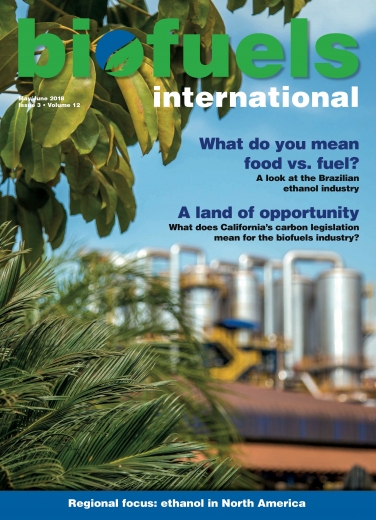
Volume 12, Issue 3
Biodiesel in the US by NBB
Feature
Trade case levels playing field for US biodiesel, by Donnell Rehagen, chief executive officer of the US National Biodiesel Board.
Ethanol in the US by Growth Energy
Feature
Opportunities in Japan and Ontario, challenges in China, by Emily Skor, CEO of Growth Energy
Ethanol in Europe by ePURE
Feature
A tale of two votes, by Emmanuel Desplechin, secretary-general of ePURE.
Brazil: What do you mean food vs fuel?
Feature
Biofuels International spoke to Geraldine Kutas of the Brazilian Sugarcane Industrial Association (UNICA) to take the temperature of the industry in Brazil: the legal supports, sources of innovation, and what the country can offer the industry at large.
A land of opportunity
Feature
Biofuels International speaks with NBB's Shelby Neal and Western Iowa Energy's Brad Wilson about what California's Low Carbon Fuel Standard means for the biofuels industry.
US biodiesel plant profitability soars but spot prices flat line
Feature
A gauge assessing the profitability of processing soybean oil into biodiesel shows production plants in the United States enjoying their best margins in more than three years, as diesel prices climb to three-year highs while soybean oil values slide to nearly two-year lows.
Supply and demand
Feature
international buyers took advantage of a depressed US ethanol market in late 2017, driving exports to a fresh record high of 827,915m3 in February. However, recovered US prices, evolving biofuel policies, and heightened trade restrictions look set to rock trade dynamics for US ethanol suppliers into 2018.
Weathering a volatile climate
Feature
Canada’s ethanol industry is in good shape and well set for further expansion, buoyed by a recent 10% blending move by the regional government in Ontario and encouraged by indications that other provinces may soon be ready to do similar.
Waste-based pioneers
Feature
Many cities all around the world struggle with huge challenges when it comes to waste management. According to the World Bank, world cities generate about 1.3 billion tonnes of solid waste per year. In the United States alone, the Environmental Protection Agency found that some 258 million tonnes of municipal solid waste were generated in 2014. That’s about five pounds (approx. 2.3kg) of...
[read more]
Getting renewable jet fuel off the ground
Feature
Velocys, an Oxford-based biofuels company, is trying to make renewable jet fuel a reality. Biofuels International caught up with the firm’s business development director, Neville Hargreaves, to talk about the company’s move into commercial operation and the nuances of biofuels in the aviation sector.
Toward hemicellulosic biofuels
Feature
As cellulosic ethanol gains ground, research in the field of synthetic biology and metabolic engineering has been looking to develop processes that derive biofuels from hemicellulosic materials. Interest in using hemicellulose, as with cellulose, is increasing because it is also derived from largely inedible plant material like stalks, cobs, etc. Thus, biofuels derived from hemicellulose are...
[read more]
Achieving economic viability in a post subsidy world
Feature
Biofuels International speaks with George Giles from Siemens about the future of biofuels plants.
Effective purification
Feature
Ethanol as a consumer chemical has a long tradition for various applications. Whether for medical, chemical or energy purposes, ethanol plays a vital role in the commodities market. Subsequently, effective purification strategies for this substance are fundamental.
Up for the challenges of cellulosic ethanol production
Feature
Pretreatment is one of the most critical and challenging areas in the cellulosic ethanol production process. The role of pretreatment is to make the cellulose accessible for the following biotechnological stage by transforming the material, both physically and chemically. A pretreatment stage, with a process solution designed for the specific raw material, will be very efficient, increase yield...
[read more]
GTW is the new UCO
Feature
In the early 1990s, Graz became one of the first cities to establish a collection of used cooking oil from households and restaurants. It was explained to people why UCO is a precious resource and the nearby SEEG biodieselp lant, built by BDI BioEnergy International, was the first plant world-wide to process UCO on an industrial scale. From then onwards, thousands of tonnes of fat waste were...
[read more]
Connecting biofuels to the rail network
Feature
With a fleet of more than 80,000 railcars, VTG Aktiengesellschaft is one of Europe’s leading wagon hire and rail logistics companies. With a fleet consisting primarily of tank cars, intermodal wagons, standard freight wagons and sliding wall wagons, the Group also delivers a full range of multimodal logistics services with a focus on rail and global tank container transportation.
Precious helium
Feature
When using helium, consideration is rarely givento the fact that after use, the helium cannot be re-used. Helium cannot be manufactured, meaning that with every use we are depleting the world’s resources of helium. Helium is produced as a byproduct from the extraction of natural gas, originally only in the US but nowadays also in Qatar, Algeria and Russia. Yet, there is increasing demand,...
[read more]






 Loading ...